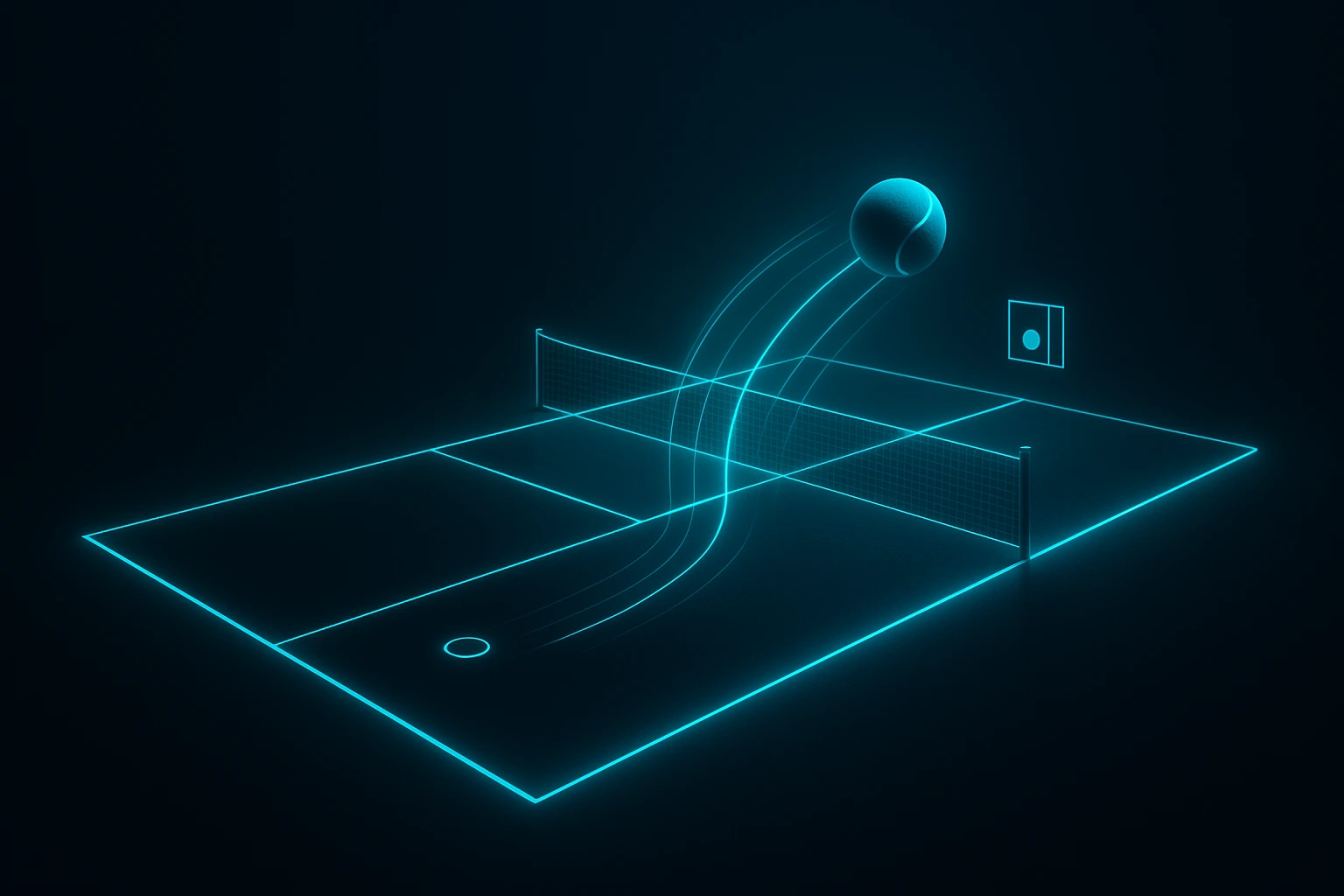
Padel is one of the fastest-growing racket sports in the world. It is also the game that leaves beginners asking the same questions in their first matches. Why can the ball touch the wall? What exactly is a golden point? And why is a serve faulted when contact is too high? The answers sit in the official FIP rulebook. We pulled out the parts that matter most when you are learning the game and condensed them into one practical guide.
The court: dimensions, net and walls
A regulation padel court measures 20 meters in length and 10 meters in width. The net divides it into two equal halves. At the center it is 88 centimeters high, and at the posts it reaches 92 centimeters. That slight difference matters more than many beginners expect when they start choosing net height and direction.
The service line sits 6.95 meters from the net on each side. A center line splits the front area into two service boxes. Behind that line is the backcourt. There are no extra horizontal markings there, so your reading of space and glass becomes crucial.
(20 × 10 meters since the first court in 1969, clarified again in the 2025 FIP revision)
The walls are part of play
At the back, both sides are closed by a continuous 3 meter glass wall. Above that you usually find metal mesh up to a total height of 4 meters. The side sections combine glass and mesh as well. Layout details vary from club to club, but the functional rule is always the same.
The key difference from tennis is simple: the walls are not obstacles, they are an active playing surface. If the ball lands on your side first, it may then rebound off your wall. That single rule creates the longer rallies and tactical patterns that make padel feel unique.
The serve: the most important rule in the game
If one section of the rulebook decides how many free points a beginner gives away, it is the serve. In padel, three conditions need to be correct at the same time.
Contact must stay below waist level
The ball has to be struck at or below the server’s waist. In practice, think belt line. If contact is too high, the serve is a fault, even if the rest of the motion looks clean.
The ball is dropped before contact
There is no full toss serve like in tennis. The server drops the ball in the backcourt, lets it bounce once and then serves diagonally into the opponent’s service box.
At least one foot stays behind the service line
During the serve, at least one foot must stay in contact with the ground behind the service line inside your service box, meaning between the center line and the side wall. You may not touch or cross the lines. Otherwise the serve becomes a foot fault.
Where the ball must land and what happens when it reaches the wall
The serve has to bounce first in the opposite diagonal service box. If it then touches the side glass, the serve is still legal and the point continues. If it hits the metal fence directly after the bounce, the serve is a fault. Beginners mix up those two cases all the time.
If the serve clips the net and still lands correctly in the service box, it is a let. The serve is replayed. If the ball touches the metal fence before the second bounce, it is no longer a let but a fault.
For beginners, one practical rule is enough: first the correct diagonal box, then side glass may help, metal fence may not. That core logic does not change between club and professional play.
The wall: when it helps you and when it costs you the point
The wall is padel’s defining feature. It also follows a very simple logic: first floor, then wall. Once that sequence is clear, most wall situations become much easier to judge.
First the floor, then the wall. Never the other way around.
A ball you want to return must first bounce on your side of the court. After that, it may touch your wall and you can still play it before the second bounce. This is the foundation of back-glass defense and one of the first real padel skills every player develops.
You lose the point immediately if your shot reaches the opponent’s wall before it lands on their court. The same idea applies to volleys. Direct wall or fence contact on the opponent’s side is not legal.
The ball bounces on your side, touches your wall and you play it back. That is standard padel. Even several wall contacts on your side are possible if you hit before the second bounce.
Your shot goes directly to the opponent’s wall or fence. The point ends immediately, even if the ball could have bounced back into court.
The “out of the cage” ball
If the ball leaves the court through a side opening or over the side structure, you may still chase it outside the cage and play it back, provided the facility design allows it. On open courts this rule creates some of the most spectacular points in padel.
Scoring: 15, 30, 40 and the golden point
Padel scoring is almost identical to tennis: 15, 30, 40, game. A set is usually won at six games, and at 6-6 a tie-break is played to 7 points with a margin of two. A match is normally played as best of three sets, so one pair must win two of a maximum of three sets.
The biggest difference appears at deuce, but even there the exact format depends on the competition.
At 40-40, one deciding point is played. The returning team chooses which side receives the serve. Whoever wins that rally wins the entire game.
Golden point was introduced on the World Padel Tour in January 2020. Premier Padel initially used classic advantage scoring and, since 2026, has used the hybrid Star Point format just like the CUPRA FIP Tour. Club events always follow the published format.
Tie-break yes, match tie-break sometimes
At 6-6, players go to a tie-break to 7 with a two-point margin. Alternative scoring methods such as a super tie-break to 10 can be used locally or in special formats, but they are not separate FIP tour categories.
What is never allowed
Some faults end the point immediately and they show up surprisingly often in beginner matches.
Double bounce.
If the ball bounces twice on your side, the point is over. Wall contact does not change that.
Ball contact with body or clothing.
If the ball hits anything other than your racket, you lose the point.
Touching the net while the ball is in play.
This applies to racket, hand, foot and clothing alike.
Reaching over the net before the ball comes to your side.
Only a rare backspin case creates an exception. If the ball bounces on your side and then spins back over the net, you may return it over or around the post, but you must not touch the net, the post or the opponent’s court.
The ball leaves the court completely.
Only on open facilities can you still rescue it from outside the cage.
Special case: por 3 and por 4
If your smash bounces in the opponent’s court and then leaves the court over the 3-meter side wall or the 4-meter back wall, the point is yours. On open courts, the opponent may still defend it from outside the cage if the safety zone and access allow it.
Positioning, rotation and side choice
Padel is played mostly in doubles. The rulebook does not force a rigid positioning model, but practical patterns help a lot, especially at beginner level.
For the serve, the server stands behind the service line inside the service box and the partner usually starts closer to the net. Service alternates game by game between teams. Within one team, the two players alternate serving as well.
Ends are changed after the first, third, fifth and every other odd-numbered game. In a tie-break, sides change every six points. Keeping track of that avoids many unnecessary debates.
Right side and left side
Padel players often talk about right side and left side roles. The right side is frequently associated with the calmer builder of points, while the left side often belongs to the more aggressive finisher. It is a common pattern, not a fixed law. Beginners should test both sides and keep the one that brings more comfort and clearer teamwork.
Five rule myths beginners keep believing
“You can toss the ball on serve like in tennis.”
No. In padel the ball is dropped, allowed to bounce and only then struck.
“If the ball leaves after my back wall, the point is always gone.”
Not necessarily. On open courts you may still chase it outside and return it legally.
“The return must land in the service box too.”
Wrong. Only the serve has that target zone. The return may land anywhere inside the opponent’s court.
“If the first serve clips the net and goes in, it still counts as one attempt.”
No. That is a let and the serve is replayed with no fault recorded.
“The server automatically has the advantage on golden point.”
Not automatically. The return team chooses the receiving side, and different tours now use different deuce formats. Even with golden point, the serve edge in padel is much smaller than in tennis.
Sources and further reading
This article is based on the current FIP rulebook, official Premier Padel publications and German padel federation resources.
Rules understood, ready to find a court?
On PadelCompass you can explore more than 500 verified courts across the DACH region with pricing, facilities and opening times. Pick a court near you and put the rules into practice.
Find courts near me arrow_forward